2027 Young Investigator Awards Call for Abstracts Now Open.
Submit Your Research for Consideration for SFNS’ 2027 Annual Awards!
All Northern California residents, fellows, and medical students in the Neurosciences
are invited to submit their research for consideration for the San Francisco Neurological Society's (SFNS)
Annual Awards, Chaired by Dr. Leo Chen.
Award Winners Receive:
$500 honorarium.
One night complimentary lodging at the Monterey Plaza Hotel.
Complimentary meeting registration for the Annual Meeting.
Award certificate.
Key Dates:
Application deadline: November 20, 2026.
Winners announced: January 11, 2027.
Awards will be given at SFNS’ 2027 Annual Meeting, taking place March 5-7, 2027 in Monterey, CA.
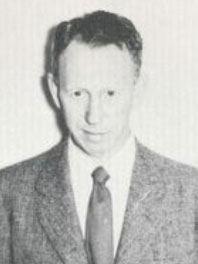
The Edwin Boldrey award recognizes the best research paper in neuroscience. It was established by SFNS in honor of the great mentor and physician, Dr. Edwin B. Boldrey.
The Boldrey award is sponsored by the UCSF Department of Neurosurgery.
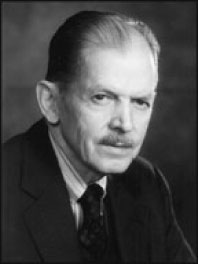
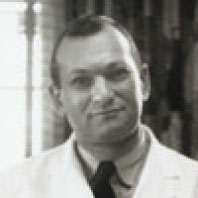
Edwin B. Boldrey, MD (1907-1959)
Edwin Barkley Boldrey was born in Indiana on July 17, 1906, the son of a minister and grandson of a doctor. His mother's parents were from Scotland and, spending summers with them as a child, he formed a strong and lasting affection for things Scottish. Influenced by his parents and his Latin teacher, he pursued a liberal arts education as a solid foundation on which to structure a life's work.
After graduation from DePauw University, he followed his growing interest in medicine, like many students during the Depression, working to continue his education. His interest in the nervous system was awakened by the work of Bailey and Cushing. Three days after receiving his M.D. degree from Indiana University in 1932, he married Helen Burns Eastland, who became his constant partner. After a surgical internship, he was offered a position at the Montreal Neurological Institute by Dr. Wilder Penfield in 1935. With Penfield, he studied and published original contributions that provided the fundamental anatomical correlates of much of the clinical physiology of motor and sensory cortical mechanisms in humans. He completed his residency in 1939.
In 1940, Dr. Howard C. Naffziger persuaded Dr. Boldrey to join the Department of Neurological Surgery at UCSF, where he served on the faculty for 48 years and as Chairman from 1951 to 1956. Dr. Boldrey was a pioneer in the therapeutic use of radiation for cerebral arteriovenous malformations and brain tumors. Among his many other contributions, to improve surgery for cervical intervertebral disc disease he developed an anterior cervical approach using discectomy without fusion, and was the first to remove a compressive lesion without requiring a bone graft.
As a physician, Dr. Boldrey demanded uncompromising attention to detail and concern in every act bearing on his patients' safety and welfare. His character was matched by his kind and gracious nature and a ready wit, and the fellowship of his colleagues and residents was a rich and valued aspect of his professional life. The Edwin B. Boldrey Lectureship at UCSF, established in 1983, reflects the maxim he adopted from Michaelangelo, and lived by- Ancora imparo, I am still learning.
The Edwin Boldrey Award for Research In The Neurosciences was established by the San Francisco Neurological Society in honor of this great mentor and physician.
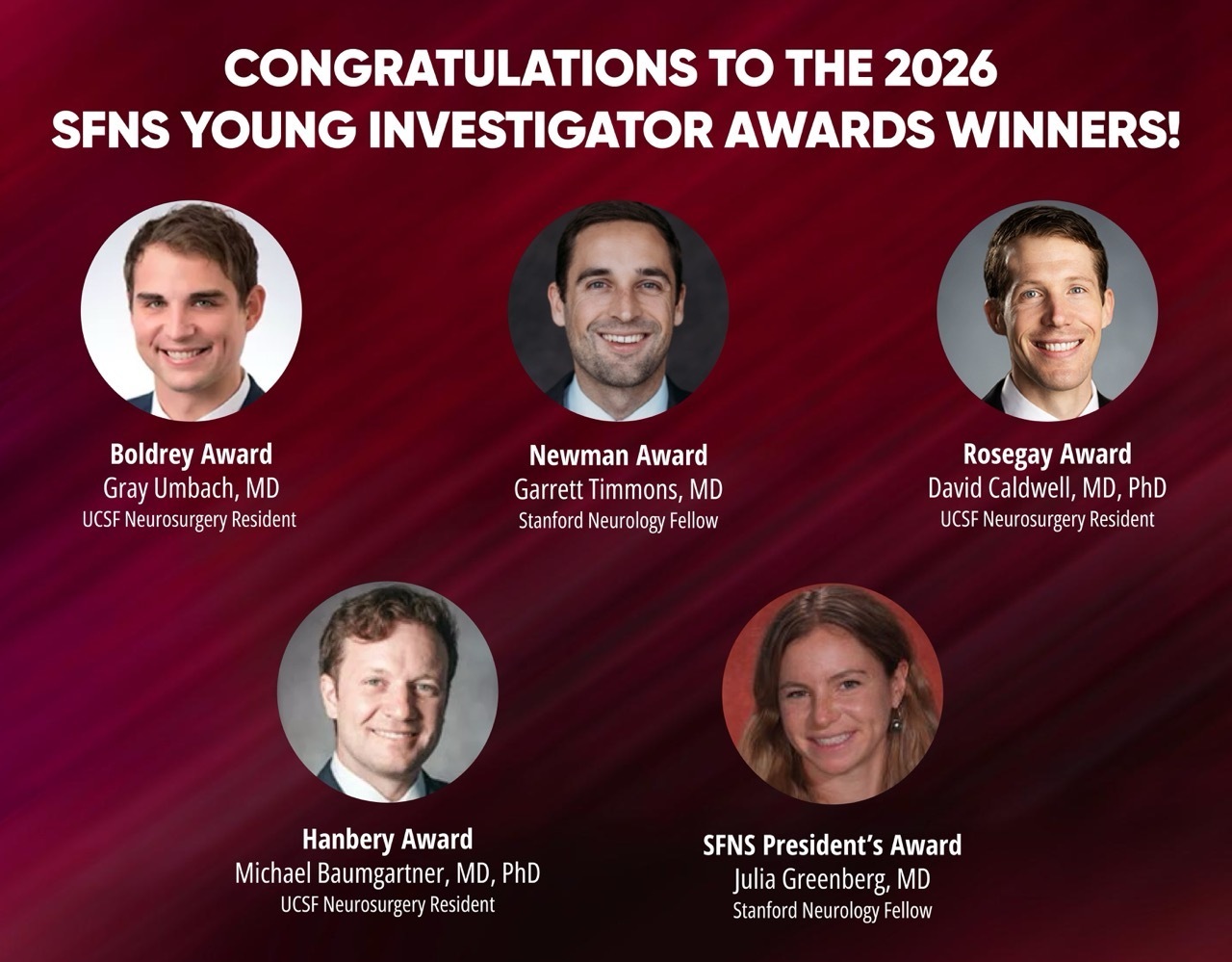
2026 Boldrey Award Winner
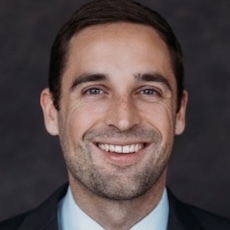
Gray Umbach, MD - UCSF Neurosurgery Resident
Dr. Umbach is recognized for his paper, "Single Neuron Recordings in Human Glioma"
Henry Newman Award
The Henry Newman award recognizes the best paper dealing with clinical neurology. It was established by SFNS in honor of Henry Wise Newman, M.D.
The Newman award is sponsored by the Stanford Department of Neurology.
Henry Wise Newman MD (1907-1959)
Henry Wise Newman, MD was one of Stanford School of Medicine’s first neurologists. He descended from a Fresno family of wine producers, rose to full Commander in the US Navy, and continued as a consultant once a week to the Oak Knoll Naval Hospital. A compact man with a wry sense of humor, he was a shrewd diagnostician and compassionate clinician.
He had many interests besides neurology, including sailing and restoring antique cars (his death occurred from a ruptured aortic aneurysm, while pushing one of these cars).
Dr. Newman left an indelible impression on those who worked with him and influenced many careers. His former Stanford colleague, Wm. Hofmann, MD, remembers him as "a pleasant mixture of Robert Benchley and W. C. Fields, and the likes of him today are nowhere to be found."
2026 Henry Newman Award Winner
Garrett Timmons, MD - Stanford Neurology Fellow
Dr. Timmons is recognized for his paper, "Cytokine Profiling in a Phase 1 Study of Autologous Fully-Humanized Anti-CD19 Chimeric Antigen Receptor T Cell (CAR-T) Immunotherapy for Progressive Phenotypes of Multiple Sclerosis"
John Hanbery Award
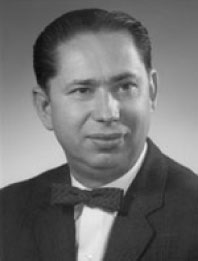
The John Hanbery award recognizes the best clinical paper covering topics in neurosurgery. It was established by SFNS in honor of Dr. John Hanbery.
The Hanbery award is sponsored by the Stanford Department of Neurosurgery.
John Hanbery, MD (1919-1996)
John Hanbery was born in Enid, OK on June 11, 1919. However, his family moved to Long Beach, California where he spent much of his childhood. He entered Stanford as a freshman in 1938 and received his undergraduate degree in 1942. Three years later he was granted an MD from Stanford University SOM, which was located in San Francisco at that time.
He participated in a residency at Stanford until 1948, at which point he embarked upon a residency in neurosurgery at the famed Montreal Neurologic Institute at McGill University. There he trained under the direct supervision of Wilder Penfield and William Cone, two of his most esteemed role models. During his residency, he helped improve shunting procedures, which were being developed to relieve neonatal hydrocephalus. He also performed experiments to help determine safe and effective topical antibiotic concentrations to be utilized during brain surgery.
In 1954, Dr. Hanbery was recruited to return to Stanford as assistant professor of neurosurgery within the Department of Surgery. Through his determined efforts, the Stanford neurosurgical residency-training program was established in 1961. Hanbery was invited to be the inaugural Professor and Executive Head of the Division of Neurosurgery in 1964. During his tenure as Head of Neurosurgery, Hanbery trained 26 residents and countless interns and medical students. His residents benefited from his talent of teaching both at the bedside and in the operating theater. He was able to analyze the most complex surgical problem and dissect it so that his students could understand the solutions. Hanbery had the ability to lead residents through delicate surgical procedures in a manner that allowed for the transfer of his surgical talents to the trainee. His former residents felt so indebted to their mentor that they established the John W. Hanbery Society in 1974 in his honor. This organization continues to be quite unique; every year residents loyal to their former chief gather to present scientific and clinical papers that can be discussed in an open and honest forum.
Dr. Hanbery retired as the Head of the Neurosurgical Unit at Stanford University SOM in 1989.
2026 John Hanbery Award Winner
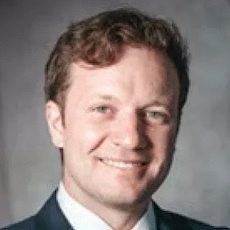
Michael Baumgartner, MD, PhD - UCSF Neurosurgery Resident
Dr. Baumgartner is recognized for his paper, "Directional Deep Brain Stimulation of Cuneiform Nucleus Improves Gait Function in Parkinson’s Disease"
Harold Rosegay Award
The Harold Rosegay award recognizes the best clinical paper covering topics in neurosurgical anatomy, history, and clinical practice. It was established by SFNS in honor of Dr. Harold Rosegay.
The Rosegay award is sponsored by the UCSF Department of Neurosurgery
Harold Rosegay, PhD, MD (1917 - 2010)
The Harold Rosegay award acknowledges the significant contributions of Col. Harold Rosegay to the UCSF Department of Neurosurgery. Dr. Rosegay joined UCSF in 1966 as a clinical associate professor on his return from service in Vietnam. He’s remembered for his love of anatomy, history, and clinical practice as it applies to the specialty.
2026 Harold Rosegay Award Winner
David Caldwell, MD, PhD - UCSF Neurosurgery Resident
Dr. Caldwell is recognized for his paper, "Utilization of Intraoperative Intracranial Electroencephalography Guidance and Brain Mapping for Cerebral Cavernous Malformation Resection in Patients with Associated Seizures"
President's Award
The SFNS President's award recognizes the best paper that addresses diversity, equity, social justice, and/or treatment disparities in clinical neurology or neurosurgery.
This award was established by Dr. Stephen Ryu, who served as SFNS’ President 2023 - 2024. It continues to be generously funded each year by Dr. Ryu.
Dr. Stephen Ryu
Chair of Neurosurgery, Palo Alto Medical Foundation
Adjunct Professor of Electrical Engineering and Neurosurgery, Stanford University
Chief Medical Officer, Paradromics
Stephen Ryu, MD, is a neurosurgeon who serves as the Chair of Neurosurgery at the Palo Alto Medical Foundation and as an Adjunct Professor of Electrical Engineering and Neurosurgery at Stanford University.
He has a BS and MS in Electrical Engineering from Stanford University and an MD from the University of California, San Diego.
Dr. Ryu completed neurosurgical training at Stanford University. During his residency, he completed a postdoctoral fellowship in Electrical Engineering and Neurosciences at Stanford University and is a world authority on brain-machine interfacing prosthetics that convert a paralyzed patient’s thoughts into usable information.
His main clinical interest has been minimally invasive spine surgery and technology. He has given over 100 invited lectures around the world on his clinical and research interests. He has also authored over 100 articles, book chapters, and reviews. He has been involved with early-stage and well-established companies in the design, development, and implementation of spine surgery devices for over a decade. He also enjoys teaching courses on happiness and personal finance, especially for those early in their careers.
2026 SFNS President's Award Winner
Julia Greenberg, MD - Stanford Neurology Fellow
Dr. Greenberg is recognized for her paper, "Management of Myasthenia Gravis Around the Globe: Consensus Guidelines Versus Realities of Practice"
The Outstanding Service Award is presented by the San Francisco Neurological Society in recognition of longstanding service and support of SFNS activities.
2024 - Gordon Li, MD
2023 - William J. McMullen, PhD, ABPP-CN
2022- Richard Delmonico, PhD
2021 - Mark Sedrak, MD, FAANS
2020 - Suzy Maska, MD, FAAN
2019 - Suketu Khandhar, MD
2018 - Steven J. Holtz, MD, FAAN
2017 – Oscar Abeliuk, MD
2016 – Eric Collins, MD
2015 - Robyn Young, MD
2014 – Eric Denys, MD
2013 - Jack Rozance, MD
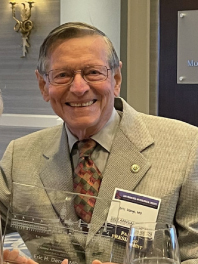
Dr. Eric Denys received the SFNS Lifetime Achievement Award at the 2022 Annual Dinner. Congratulations Dr. Denys!